But solar answers only the easy half of the question. The sun sets every evening and weakens through the monsoon — and a business does not. A three-shift factory runs through the night. A continuous-process plant never idles. A data centre draws full load at 3 a.m. The hours a company needs firm power the most are precisely the hours solar supplies the least.
That gap is where wind earns its place — not as an alternative to solar, but as the other half of a serious energy strategy: the source that generates when the sun has clocked off. For any Indian business deciding how to secure reliable, affordable, low-carbon power for the next two decades, wind is no longer optional reading. It is the part of the plan that keeps the lights on after dark.
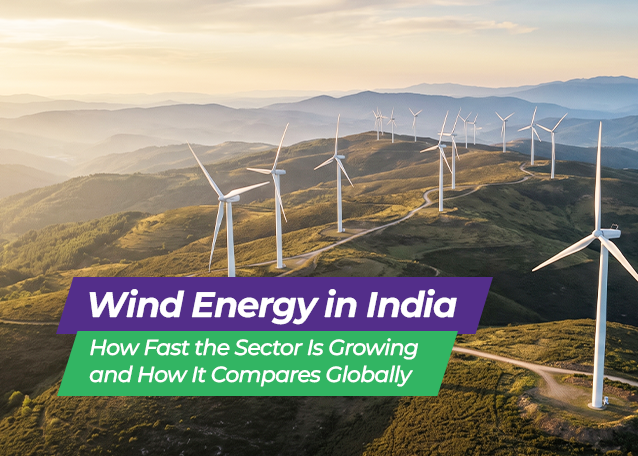
The market has already moved on this. India added a record 6.1 GW of new wind capacity in FY26 — its strongest year ever, and a 46% jump on the year before. Cumulative wind capacity has crossed 56 GW, against a national target of 100 GW by 2030. Much of that demand is now coming from commercial and industrial buyers, increasingly through green open access and wind-solar hybrid contracts. Wind is not growing because it is fashionable. It is growing because large buyers have worked out what it does that solar cannot.
For Indian businesses, the benefits of wind power come down to more than carbon. The wind energy benefits that move a procurement decision are timing, reliability and cost certainty. Wind generates in the evening, at night, and through the monsoon — exactly when solar output falls — so a business is supplied by clean power across far more hours of the day. Under a long-term contract, it fixes the tariff for 20 to 25 years, insulating a company from volatile grid and diesel costs. Paired with solar and storage in a hybrid plant, it moves a business toward round-the-clock clean supply. And it backs Scope 2 and RE100 commitments with electricity that is physically delivered, not balanced on paper.
1. Wind generates when solar can’t. This is the benefit that matters most and gets discussed least. Across India’s wind-rich states - Gujarat, Karnataka, Maharashtra, Tamil Nadu - wind generation typically strengthens in the evening and overnight, and peaks through the southwest monsoon from June to September. That is precisely the window when solar fades or drops out entirely. For a business, the practical effect is simple: more of the day is met by clean power, and less of the night is met by the grid or a diesel set.
2. More predictable, lower long-term energy costs. A long-term wind agreement typically fixes the tariff for 20 to 25 years. While grid tariffs drift upward and diesel stays exposed to fuel prices, this gives finance teams something rare — an energy cost they can model a decade out. The arithmetic improves further for inter-state supply: the waiver on inter-state transmission (ISTS) charges for wind runs until June 2028, lowering the delivered cost for companies sourcing wind power across state lines. The honest caveat is that open access carries its own charges, such as the cross-subsidy surcharge, and these vary state to state. The headline tariff is never the whole bill — and a serious provider will model the landed cost, not just the rate.
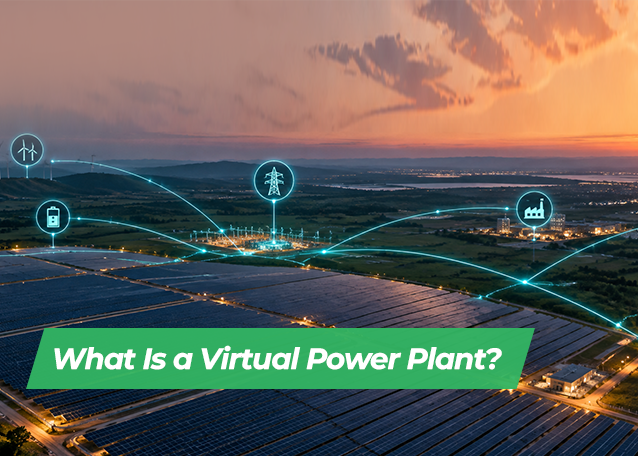
3. Far greater reliability when wind is paired with solar and storage. Wind on its own is variable; some seasons and some hours are stronger than others. So is solar. Their strong periods, though, rarely coincide. Combine the two on a single connection, add a battery energy storage system (BESS) to shift power into the remaining gaps, and you have a hybrid power plant — one contract, one grid connection, delivering steadier output than either source could alone. For most C&I buyers, this is where wind stops being a standalone idea and becomes part of a dependable supply.
4. A genuine path to round-the-clock clean power. For the most demanding loads — continuous-process industry, and data centres now rising across India — power is needed every hour, not just when the wind blows or the sun shines. This is what makes wind power for industry more than an environmental choice: wind is a core building block of firm, round-the-clock renewable supply precisely because it covers the hours solar leaves open. Layered with storage, a wind-led hybrid can underwrite the 24x7 clean power that uptime-critical operations actually require.
5. Decarbonisation that survives scrutiny. RE100 and science-based targets are no longer voluntary signalling — they are board commitments that get audited. Physically delivered wind power supports Scope 2 reduction with real megawatt-hours flowing into a company’s operations, not certificates bought to balance a spreadsheet. When a sustainability claim has to stand up to a customer’s due diligence or a regulator’s question, physical delivery is what holds.
6. More output from the same grid connection. Securing grid connectivity and evacuation infrastructure is one of the hardest, slowest parts of building renewable capacity in India. A wind-solar hybrid uses that hard-won connection far more fully — wind and solar share the same evacuation line, raising its utilisation across the day rather than leaving it idle through long stretches. For a business, infrastructure that works harder is part of what makes hybrid wind power competitive in cost.
7. Insurance against single-source risk. A weak solar season, a low-wind year, a grid disturbance — every single source carries its own exposure. Spreading supply across wind and solar reduces dependence on any one of them, and on an unreliable state grid. Energy security is rarely the headline reason a business first looks at wind. It is often the reason it stays with it.
None of this is to pretend that wind power for industry is easy to deliver. Wind is the hardest technology to build. Sites are remote and resource-dependent; turbines are large and demanding to transport and erect; and the evacuation infrastructure that carries the power to the grid has to be ready before a single unit flows. Substation readiness, land, and state-level permitting separate a wind project that is announced from one that gets commissioned.
This is the part we take seriously, and our portfolio shows it. At Thenampatti in Tamil Nadu, we are building a 156.8 MWp multi-technology plant — 118.5 MWp of solar paired with 37.8 MWp of wind — supplying corporate buyers including Daimler and the TVS Group under a 25-year power purchase agreement. At Solapur in Maharashtra, our 611 MWp project combines solar, wind and storage. The project was awarded through an SJVN bid, with our company serving as the sole developer.
For a business evaluating wind, the lesson is the one India’s energy transition keeps teaching: the ambition is rarely the problem. The execution is. The benefit of wind only reaches your meter if someone can actually build the project and connect it.
India does not lack reasons to adopt wind power. It has a record year behind it, a 100 GW target ahead, and an industrial base that increasingly needs clean power around the clock. What separates the businesses that capture wind’s benefits from the ones still talking about them is not conviction. It is choosing partners who treat wind as something to commission, not just to promise.
The benefit of wind, in the end, is not that it is green. It is that it is there when the sun is not — and for a business that runs after dark, that is the difference between a sustainability statement and a reliable supply of power.
Wind generates in the evening, at night and through the monsoon — when solar output falls - so businesses draw clean power across more hours of the day. It fixes energy costs over a 20–25 year contract, strengthens reliability when paired with solar and storage, supports Scope 2 and RE100 targets with physically delivered power, and reduces dependence on the state grid.
Wind on its own is variable, but combined with solar and a battery energy storage system (BESS) in a hybrid plant, it delivers a sustained and reliable output. For data centres, a wind-led hybrid is a practical solution to clean power.
Solar generates during daylight and drops at night and through the monsoon; wind often does the opposite, generating strongly in the evening, overnight and during the monsoon months. Used together, they cover far more of a company’s load than either can alone.
Not by itself, but as part of a wind-solar-storage hybrid, it can. Wind fills many of the hours solar cannot, and batteries shift power into the remaining gaps — together underwriting firm, round-the-clock renewable supply.
Gujarat, Karnataka, Maharashtra and Tamil Nadu lead India’s wind generation and accounted for much of the record capacity added in FY26. The right site for any specific project still depends on its wind resource and grid access.