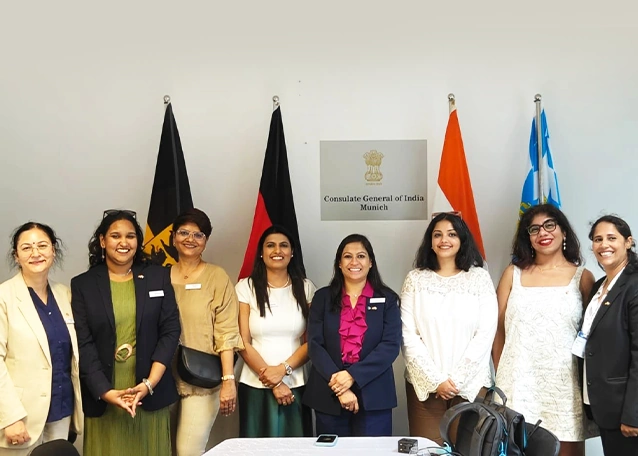
This June, NSEFI and BSW sent India's first all-women renewable energy delegation to Germany — WISE, Women in Sustainable Energy - nine days through Konstanz, Freiburg, Stuttgart and Munich, closing at Intersolar Europe. I travelled with Monika Rathi from Veno Solar, Manisha Nair from Blupine Energy, Archna Koul Sumbly from Hero Future Energies Kuhoo Saxena from Renew Power and Catherine Leon, with Muskaan Sethi holding it all together from NSEFI's side. I expected a tech-cum- data-cum-high level knowledge transfer tour. I came home with something closer to a mirror.
At Fraunhofer ISE in Freiburg, we sat inside one of the world's most respected solar research institutes and talked agrivoltaics and grid stability like it was the most ordinary conversation in the world - because by then, it was. At Next2Sun outside Stuttgart, I finally understood vertical solar PV beyond the theory: panels standing upright, generating power when the grid actually needs it, instead of flooding it at noon. Two days later, SINN Power in Munich applied the same logic to water - floating solar that tilts with the wind and works around Germany's surface-coverage rules. None of it was beyond us. It never was. What's actually been missing is fewer of us being handed the microphone to say so.
At K2 Systems near Stuttgart, our point of contact was Kathrina David, the CEO of K2 Systems whose mounting systems now carry over 40 GW installed worldwide. Nobody at that table treated her seniority as unusual. At Fraunhofer, half of all PhD funding goes to women researchers, by policy, not gesture. An organization - led by a woman CEO - the conversation wasn't whether to build a leadership pipeline for women, but how fast.
Then came our afternoon at TUM, Technical University of Munich addressing global women energy leaders on what it's actually like building a renewable energy career in India. I have spoken at panels before. I have never felt as humbled as watching women who would spent decades in teaching or establishing their own business nod along, recognising every word.
That thread carried through to Intersolar, at "Women Powering Progress," under the global Women Energize Women banner. There I met Phuong Tran - Coordination Board member of Women in Energy Vietnam and founder of the Energy Efficiency Network Vietnam - building the same thing we are building at WISE, half a world away, and doing it with a network of roughly 200 active members, unusually engaged compared to similar groups elsewhere. Listening to her, I understood this isn't just an India-Germany story. It's Hanoi, Freiburg and Delhi.
That's the real, uncomfortable discovery of this trip: this isn't an India problem or a Germany problem or a Vietnam or a Africa problem. It's the same shape everywhere, just wearing different clothes.
Every organisation doing this well - Fraunhofer, ISC, K2, - wasn't only writing better HR policy. They were telling a louder story about what a career here actually looks like for a woman: named CEOs, not folded into "leadership team" slides; women photographed on-site, not only in CSR brochures. India's renewable sector is scaling faster than almost anywhere else. We have the jobs. What we don't consistently have is visible proof that they are open to women in technical and field roles, not just sustainability seats. A fifteen-year-old deciding if engineering is "for her" isn't reading an HR handbook she's looking at who gets photographed on site.
So here's what I would like to pick up as a Chair of WISE next: turn our women in technical roles into an ongoing, well-told archive, not a one-off list. Take WISE's existing workplace-conditions label out of pilot and into public view, with a real leaderboard and real stories behind it. Build a formal mentorship bridge with Germany and Vietnam. And insist, every time, that our technical women sit inside the main programme at summits, not beside it.
I didn't fully understand, before this trip, how much of what I have felt in my own career was structural rather than personal - a gap built into every country doing this work, not a gap in me. That,s the story I came home to tell.