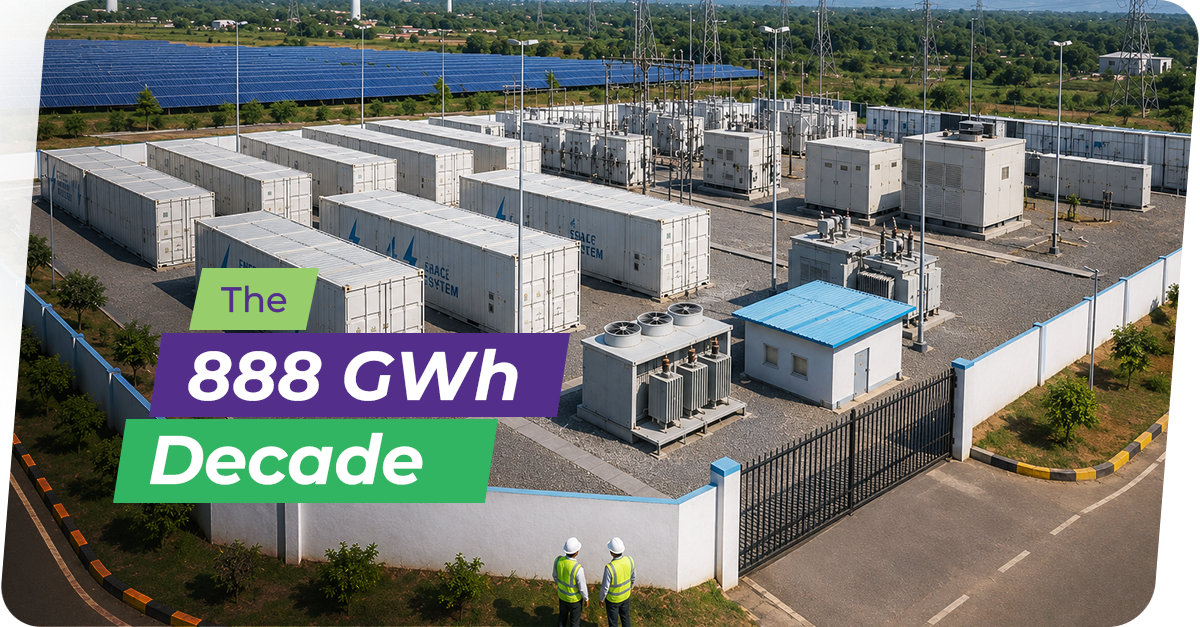
Answer at a glance: India's energy storage requirement is projected to grow from roughly 1 GWh at the start of 2026 to 888 GWh by 2035-36, according to the India BESS Market Review released by IESA and Customized Energy Solutions at India Energy Storage Week 2026. For a business buying power, the significance is what a storage-rich grid puts on the table: firm green power contracts that deliver clean electricity on a committed schedule, for more hours of the day, at a predictable cost. As energy storage in India moves from pilot to mainstream, shaped and round-the-clock green supply is becoming a standard contract offering rather than a bespoke experiment.
The headline finding is stark. India's energy storage requirement is set to grow from about 1 GWh to 888 GWh by 2035-36. The projection comes from the India BESS Market Review, released by the India Energy Storage Alliance (IESA) and Customized Energy Solutions (CES) at India Energy Storage Week (IESW) 2026 in New Delhi, and has been widely reported in the national press.
Behind the headline, the report describes a market already accelerating:
“The projected requirement of 888 GWh marks a new phase in India's clean energy journey, with energy storage becoming central to achieving a reliable and sustainable electricity system,” said Debmalya Sen, President of IESA, at the report's release.
The BESS market in India is, in short, moving from a handful of pilots to national infrastructure — the same trajectory solar followed a decade ago. What matters for a business buying power is what that buildout changes in the contracts on offer.
Definition: Firm green power is renewable electricity delivered on a committed schedule — a fixed block of the day, the buyer's actual consumption profile, or all 24 hours — rather than only when the sun shines or the wind blows. It is made possible by combining generation sources (solar, wind, hybrid) with energy storage, which holds surplus generation and releases it in the hours the buyer needs. Delivered around the clock, it is called round-the-clock renewable energy (RTC), or in regulatory usage, firm and dispatchable renewable energy (FDRE).
Until recently, a renewable power contract came with a shape problem. A solar contract delivered generously at midday and nothing after dark; a wind contract followed the seasons. The buyer's operations did neither. The gap between the two was filled by the distribution utility — at retail tariffs, and increasingly at time-of-day rates that price evening consumption at a premium.
Storage closes that gap on the supply side of the contract, and the national buildout is what makes it available at scale rather than as a one-off engineering exercise. National tenders for firm and dispatchable renewable energy now run to their ninth round: SECI's FDRE-IX tender, whose bids closed in July 2026, seeks 1,200 MW of renewable capacity backed by co-located storage to deliver a four-hour block of supply in the evening peak window, under 25-year power purchase agreements. Supply that follows demand is now a standard product in national procurement — and the same contract structures are flowing through to the commercial and industrial market.
For C&I buyers specifically, IESA projects that commercial and industrial energy storage installations will grow from under 1 GWh in 2025 to 23–31 GWh by 2032. The menu a business can contract for is widening accordingly:
The engineering behind these offerings is the producer's job, not the buyer's. What the buyer sees is the outcome: a contract whose delivery profile looks like their consumption, and whose cost is set for the tenure.
The practical value of the storage decade, for a business, is measured in hours of budget certainty.
Every unit a business consumes outside its renewable contract is bought at the DISCOM's retail tariff — among the highest paid by any consumer category in most states, revised year on year, and now overlaid with time-of-day pricing in 23 states and five union territories. Every additional hour a green power contract can cover is an hour moved from that escalating, externally-set price to a contracted, predictable one.
Storage is what extends those hours. A solar contract might cover a third of a round-the-clock facility's consumption; a storage-backed hybrid contract can cover most of it. As general market context, published analyses of national auctions find that storage-backed renewable supply has become cost-competitive with new conventional generation, with contracted prices that stay flat over the tenure — while retail industrial tariffs have historically moved only upward. These are benchmarks from public tenders, not any single producer's pricing; each project and contract differs. But the direction matters for planning: the buildout is steadily widening the share of consumption that can sit inside a fixed-price, clean contract.
There is a sustainability dividend too. Clean power that arrives only at midday greens a third of the operating day; firm green power counts toward RE100, net-zero, and BRSR commitments across the hours a business actually runs. Ensuring reliable power while advancing climate commitments stops being a trade-off and becomes a single procurement decision.
The buildout is a coordinated national effort. Government has put the enabling framework in place: viability gap funding for battery storage (a March 2024 scheme for 13,220 MWh, followed by a June 2025 scheme for 30 GWh), waivers of inter-state transmission charges for storage projects commissioned by mid-2028, and storage obligations on distribution utilities. The Central Electricity Authority projects over 60 GW of storage will be needed by 2029-30 on the way to the 2035-36 requirement.
The report is equally clear about the execution challenge: financing at this scale — an estimated ₹4–5 lakh crore for the battery component alone — depends on lender confidence in a young asset class, and on developers with the track record to earn it. That is where independent power producers fit: building the generation-plus-storage projects that turn policy and tender frameworks into delivered, bankable capacity, in collaboration with utilities and regulators. This is the practical work of navigating energy security while accelerating the low-carbon transition.
The right starting point is not a technology but a question: which hours of our consumption do we want at a contracted cost? A daytime-heavy operation may be well served by solar with modest storage. A continuous process plant, a data centre, or a multi-shift factory should be evaluating shaped or round-the-clock supply — contracts that were niche three years ago and are now standard offerings.
Resolven builds exactly these solutions. With a multi-gigawatt portfolio of wind, solar, hybrid, and battery storage projects across India — spanning utility-scale supply and 24x7 clean power solutions for enterprises — Resolven engineers generation and storage around each customer's consumption profile, so that businesses receive dependable green power for more hours of the day at a cost they can plan around. As the storage decade unfolds, that is the offer C&I stakeholders should expect from their energy producer: bridging today's energy needs with tomorrow's clean solutions.
The 888 GWh decade will be reported as an infrastructure story. For businesses, it is really a procurement story — the decade in which clean power stopped being an intermittent supplement and became the dependable core of the energy budget, and a measurable contribution to the sustainability outcomes that customers, investors, and regulators track.
It is available now. National FDRE tenders have run for several rounds, and storage-backed C&I contracts are in operation today. The 888 GWh buildout takes these offerings from early availability to standard practice — more suppliers, more delivery profiles, deeper competition.
No. In a long-term supply contract, the producer owns, sizes, operates, and eventually augments the storage. The buyer contracts for an outcome — a delivery profile and a price — and the producer carries the technology risk.
A contracted supply is unaffected — its delivery obligations and price are fixed in the agreement. The projection matters mainly for future contracts: a larger storage base means more shaped and round-the-clock offerings to choose from, and a more competitive market for them.