Answer at a glance: India's wind sector is winning auctions again. SECI's 2 GW inter-state wind tender concluded in July 2026 with 1,495 MW awarded to twelve developers at tariffs of ₹3.78–3.85 per unit, capping a year in which India added a record 6.05 GW of wind capacity. For a business, the revival matters because of when wind generates: through evenings, nights, and the monsoon months — the hours solar cannot reach. Wind energy for businesses means a green power portfolio that covers more of the day and more of the year at a contracted, predictable cost — and less electricity bought from the DISCOM at rising retail tariffs.
The facts of the auction are quickly told. SECI tendered 2,000 MW of inter-state (ISTS-connected) wind capacity in April 2026 and announced results on 16 July. Twelve developers won a combined 1,495 MW under 25-year power purchase agreements, with winning tariffs settling in a narrow ₹3.78–3.85 per unit band. The winners' roster spans established names — Gentari (the lowest bidder), NLC India Renewables, Torrent Green Energy, EDF Renewables' Halvad, CESC's Purvah Green Power — alongside Resolven, whose Ganeko Four Energy entity secured a 200 MW project in Karnataka.
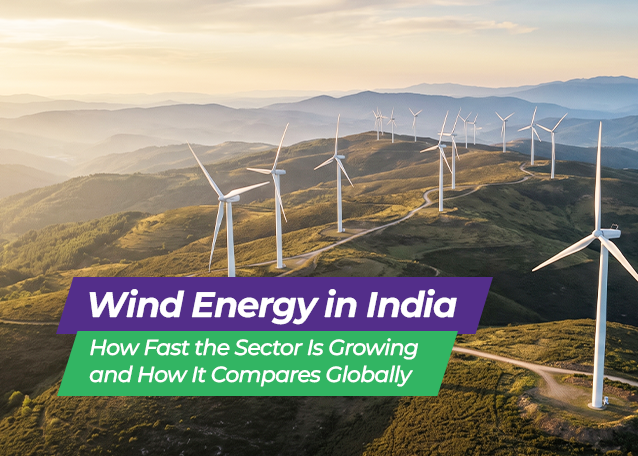
The auction is one data point in a broader turn. India added 6.05 GW of wind in FY2026 — its highest annual addition in nearly a decade — taking cumulative capacity past 56 GW, with a national trajectory pointing toward roughly 155 GW by 2035-36. After several years in solar's shadow, utility-scale wind in India is again attracting serious capital, serious developers, and consistent tender activity across standalone wind, hybrid, and round-the-clock formats.
Notably, the market's discipline is part of the story: 1,495 MW of the 2,000 MW on offer was awarded, with developers bidding selectively for sites and capacity they are confident of delivering. The winners' list is a roster of well-capitalised, execution-focused producers — the kind of counterparties long-term power buyers want on the other side of a contract.
Definition: Utility-scale wind refers to large wind power projects — typically tens to hundreds of megawatts — that feed electricity into the transmission grid, rather than serving a single site behind the meter. Connected to the inter-state transmission system (ISTS), a utility-scale wind project in one high-resource state can supply consumers anywhere in India through long-term contracts.
The case for wind in a corporate energy portfolio rests on its generation profile — wind produces when solar does not:
There is a reporting dividend too. Renewable supply that reaches into evenings and the monsoon extends the hours a business can green — which is what moves RE100, net-zero, and BRSR numbers from a daytime achievement toward a round-the-year one.
Businesses have noticed. Roughly three-quarters of FY2026's record wind additions — nearly 4.5 GW — were driven by commercial, industrial, and captive buyers through open access routes. The corporate market, in other words, is not waiting for the revival to be declared; it is the revival's largest customer.
As general market context from published auction results: winning tariffs in the July 2026 SECI round settled in a narrow ₹3.78–3.85 band — competitive, stable price discovery from a field of experienced developers. These are national auction benchmarks, every supply contract is shaped by its own project, location, and delivery profile. But the signal for a power buyer is direction: utility-scale wind is being contracted at predictable long-term prices by disciplined counterparties,
The practical question for a buyer is not whether wind is back — the auction results settle that — but which producer can engineer it into a dependable supply. Wind projects reward developers who pick sites well, secure connectivity early, and commission on schedule.
Resolven is among the producers building that revival: its 200 MW SECI-awarded wind project in Karnataka joins a multi-gigawatt portfolio of wind, solar, hybrid, and storage projects across India's high-resource states.
India's wind revival is not nostalgia for an older technology — it is the market recognising that the energy transition needs generation in the hours solar cannot serve. For businesses, that makes wind a strategic buy: wider coverage, steadier budgets, and faster progress on the sustainability commitments that customers, investors, and regulators track.
No. Utility-scale wind projects connected to the inter-state transmission system can supply consumers in other states through open access contracts. The wind blows in Karnataka or Gujarat; the power and its benefits arrive wherever your facility is.
Wind is variable hour to hour but strongly patterned across the year — strongest in the monsoon and in evening hours. Producers manage the variability by pairing wind with solar and, where needed, storage, so the contracted supply profile is dependable even though any single turbine's output is not.
Through a long-term power purchase agreement with a producer, delivered over the grid under open access — no turbines on your premises, no change to your facility's wiring. What changes is the energy bill: a larger share at a contracted price, a smaller share at the DISCOM's retail tariff.