Think of the power bank you carry for your phone, or the inverter that keeps a home running through an outage. A BESS applies the same idea at the scale of the power system. It charges when electricity is abundant and inexpensive — typically in the middle of the day, when solar generation peaks — and discharges when demand rises and generation falls. Nothing about the electricity changes; only its timing does. A single installation can be small enough to serve one industrial campus or large enough to help supply a city’s evening peak.
Definition: A Battery Energy Storage System (BESS) is a grid-connected installation that combines rechargeable batteries, power conversion equipment, and control software to store electrical energy and release it on demand. Storage capacity is measured in megawatt-hours (MWh). A BESS does not generate electricity — it time-shifts it, holding energy from the moment it is produced to the moment it is needed.
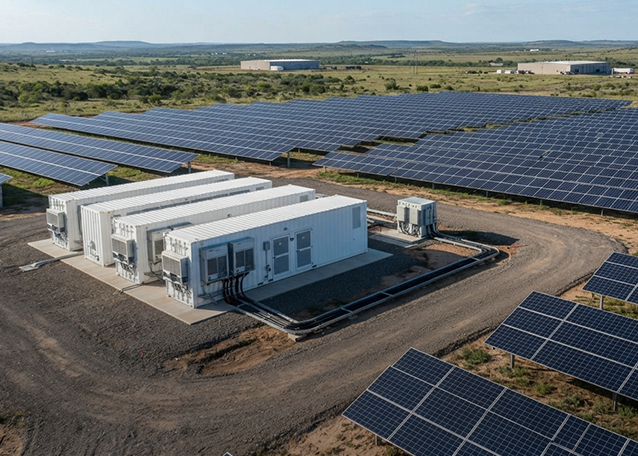
Every battery storage system has three parts. The batteries — most commonly lithium-ion — hold the energy. Power conversion systems turn the batteries’ direct current into the alternating current the grid uses. A control layer decides, second by second, when to charge and when to discharge. For most readers, the technology matters less than the outcome it enables: electricity that arrives when it is wanted, not only when the weather allows.
BESS is the fastest-growing of the energy storage systems available to power planners — a family that also includes pumped hydro storage. Batteries can be built in months rather than years, sited almost anywhere, and instructed to respond in milliseconds. That combination explains why they anchor India’s energy storage roadmap.
Four use cases account for most of what a BESS does today.
Energy shifting: It stores low-cost midday solar energy and supplies it during the morning and evening peaks, when demand is highest and solar output is low or zero.
Peak support: It adds supply in the hours when the power system is most stretched, reducing dependence on costlier peaking generation.
Grid services: Under the direction of grid operators, batteries help hold frequency and voltage steady, responding faster than conventional plants can.
Firming renewable supply: Combined with solar and wind, storage lets a project commit to a delivery schedule — the foundation of dependable, round-the-clock clean power for utilities and for enterprises.
Solar plants generate when the sun shines. Wind plants generate when the wind blows. The grid, however, needs power on demand. For years this was the standard argument against renewables: the energy was clean and increasingly inexpensive, but it could not be scheduled. Storage closes that gap.
A renewable project with a BESS can make commitments. The battery charges on the midday solar surplus and discharges into the evening peak, so the combined plant can promise delivery against the buyer’s demand profile — and accept penalties if it falls short. India’s Firm and Dispatchable Renewable Energy (FDRE) bidding framework, notified by the Ministry of Power in June 2023, is built on exactly this idea: long-term contracts for renewable power that behaves like conventional power, with energy storage systems as the enabling technology.
This is no longer theoretical. In March 2025, operating under the Zelestra brand, Resolven was awarded an FDRE contract by SJVN, a central public sector utility. The winning solution, announced in the company’s press release, is a 500 MW multi-technology project at Solapur, Maharashtra — approximately 250 MWdc of solar, 180 MW of wind, and a 90 MWh battery energy storage system — expected to come online in 2027 and generate more than 815 GWh of clean electricity a year.
Grid operators balance supply and demand every second of the day — work led by government and utility institutions, and work that grows harder as demand climbs. India’s peak power demand touched a record 270.8 GW in May 2026, and the daily peak increasingly falls in evening and night hours, when cooling demand stays high and solar generation is unavailable.
Battery storage supports that balancing work in three ways. It supplies the peak, discharging in the hours of maximum stress. It absorbs the midday solar surplus that might otherwise be curtailed, returning that energy when demand is high. And it responds to grid operators’ instructions in milliseconds, helping keep grid frequency stable. In each case the role is complementary: planning and operating the grid remains with the government and its institutions, while developers engineer generation and storage around that framework.
Policy reflects this. The Central Electricity Authority projects that India will need roughly 236 GWh of BESS by 2031–32 as part of its total energy storage requirement. The Ministry of Power’s Viability Gap Funding scheme — expanded in June 2025 with ₹5,400 crore of support for 30 GWh of new capacity — is designed to accelerate that buildout. The market is responding: India added a record 4.6 GWh of battery storage in the first quarter of 2026, taking cumulative installed capacity to about 5.9 GWh, according to Mercom India. For investors, the distance between today’s installed base and the 2032 requirement is the story — a policy-backed pipeline with years of committed growth ahead.
Does a BESS generate electricity?
No. A battery storage system stores electricity generated elsewhere — typically by solar and wind plants — and releases it later. That is why storage is usually planned alongside renewable generation rather than instead of it.
How long can a BESS supply power?
Most grid-scale systems in India are sized to discharge for two to four hours at full output. That window is deliberate: it covers the morning and evening peak hours, which is where stored energy is most valuable to the grid.
Why does BESS matter for India’s renewable energy targets?
India is working toward 500 GW of non-fossil capacity by 2030. Storage is what allows that capacity to serve demand after dark, letting planners count renewable projects as dependable supply rather than weather-dependent supply.
BESS is the bridge between renewable capacity and reliable power. For Resolven, storage is one of the tools — alongside wind, solar, and hybrid projects — for delivering dependable clean energy in collaboration with utilities and regulators, and a central part of the sustainability commitments our stakeholders measure us against.