FDRE - Firm & Dispatchable Renewable Energy - is renewable power engineered to behave like conventional power: solar and wind generation is combined with energy storage so that supply can be scheduled against a committed demand profile, including morning and evening peak hours. The Government of India notified competitive bidding guidelines for FDRE in June 2023 to procure renewable power that distribution utilities can depend on - not just renewable capacity. It has since become one of the defining procurement formats in India’s utility-scale renewable energy market.
Firm & Dispatchable Renewable Energy (FDRE) is electricity from renewable projects — typically solar and wind paired with battery energy storage - that is contracted to be firm (dependably available at committed levels) and dispatchable (schedulable against the buyer's demand profile, including peak hours), rather than supplied only when the sun shines or the wind blows.
A conventional power plant can be told when to generate. Solar and wind plants generate when the resource is available. FDRE closes that gap, both contractually and technically. The developer builds a portfolio — solar, wind, and storage, often across multiple sites - and commits to a supply shape rather than just a volume of energy. The buyer, typically a distribution utility procuring through a central agency, receives green power that follows demand.
The first phase of India's renewable energy story was about capacity. Installed solar capacity crossed 150 GW in March 2026, and the country added a record 44.6 GW of solar in FY 2025-26 alone, on the way to the national target of 500 GW of non-fossil capacity by 2030.
The second phase is about dependability. India's peak electricity demand crossed 250 GW in 2024 and continues to rise - and a large part of that peak falls in morning and evening hours, when solar generation is low or absent. Conventional solar and wind power purchase agreements deliver clean energy, but not assured supply in those hours, so distribution utilities have continued to rely on other sources for balancing. FDRE bidding was introduced to procure renewable power in a form utilities can plan around: committed, schedulable, and available through peak windows.
On 9 June 2023, the Ministry of Power notified the Guidelines for Tariff Based Competitive Bidding Process for Procurement of Firm and Dispatchable Power from Grid Connected Renewable Energy Power Projects with Energy Storage Systems - commonly referred to as the guidelines on FDRE. Three design choices stand out:
The framework has been actively maintained, with the ministry issuing periodic clarifications - most recently in 2026 on the treatment of energy storage charging and sale of non-renewable power from storage under FDRE projects.
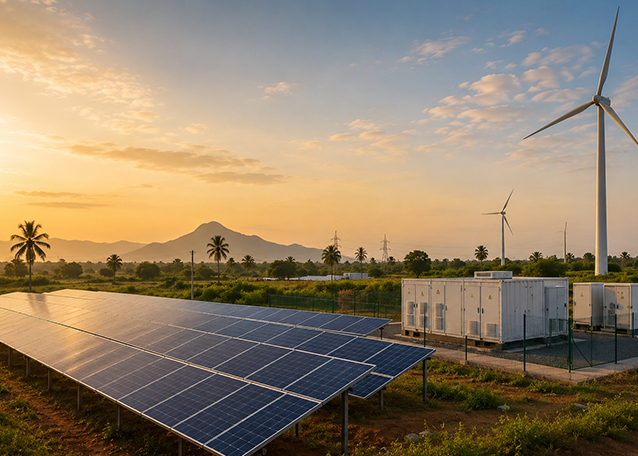
The mechanics matter less than the outcome, but the outline is simple. Solar generates through the day; wind contributes across evenings, nights, and the monsoon months; and batteries store surplus generation and release it in the committed hours. The portfolio is sized and operated so that the contracted supply profile is met, block by block, with scheduling coordinated through the grid operators as for any generator.
That discipline moves complexity from the buyer to the developer. Designing and operating a multi-site, multi-technology portfolio against penalties is demanding work - which is why FDRE has favoured experienced, well-capitalised renewable energy platforms.
It supports the peak. FDRE contracts concentrate assured renewable supply in morning and evening peak windows - the hours when the power system is under most stress.
It improves renewable integration. Storage absorbs midday solar surplus that might otherwise be curtailed and returns it when demand is high, complementing the balancing work of grid operators.
It makes green capacity plannable. Because supply is committed against a demand profile, distribution utilities can count FDRE toward resource adequacy in a way plain-vanilla renewable PPAs do not allow.
It anchors India's storage buildout. FDRE tenders have become one of the principal drivers of grid-scale battery deployment. Industry tracking reports that central and state agencies have tendered more than 14 GW of FDRE capacity since the 2023 guidelines, and India's first FDRE project entered commissioning in April 2026.
FDRE is moving the market from single-technology projects toward multi-technology platforms that combine wind, solar, and storage. Auction results are published by the procuring agencies; as general market context, recent FDRE tranches have discovered tariffs below ₹5 per kWh - dependable green power at rates competitive with conventional procurement.
Resolven, a renewable energy platform in India that builds on the foundation established under Zelestra, is among the developers building this new asset class. In March 2025, under the Zelestra India identity, the platform signed a long-term FDRE contract with SJVN, a public sector enterprise - enabling a 500 MW wind-solar-storage portfolio at Solapur, Maharashtra, with approximately 250 MWdc of solar, 180 MW of wind, and a 90 MWh battery energy storage system, committed to firm supply through Maharashtra's morning and evening peak hours. The portfolio is expected to generate over 815 GWh annually - equivalent to the needs of more than 225,000 households - and avoid around 0.7 million tonnes of CO₂ emissions each year, with commissioning targeted for 2027.
"This is a transformational project that will combine solar, wind and battery storage to deliver clean energy at all points of the day in Maharashtra, including the critical peak hours when homes and businesses need reliable electricity the most," said Parag Sharma, Chief Executive Officer, Resolven
Resolven has also been awarded a 1.2 GWe Firm & Dispatchable Renewable Energy (FDRE) project by Satluj Jal Vidyut Nigam (SJVN), an Indian public sector undertaking in the Navratna Category at a tariff of Rs 4.25 per unit.
This project, which combines solar, wind, and Battery Energy Storage Systems (BESS) for Assured Peak Power Supply, is situated in the Sitamau district of Madhya Pradesh, India. It has the capacity to produce ~ 850 GWh of electricity each year, enough to meet the needs of over 210,000 Indian households, while also anticipating a reduction of ~810,000 tonnes of CO2 emissions annually. Resolven will supply SJVN with clean energy beginning in 2027.
Sajay K.V, Chief Executive Officer, Zelestra India commented, "We are excited to announce our largest multi-technology project win achieved in a single bid. Our strategy to optimize project cost through co-located sites have helped us to successfully transition from a single-technology, single-market focus to a diversified portfolio encompassing multi-technology solutions. With a strong foundation of 5 GW secured by 2026, we will now focus on our long-term vision."
Projects like these are how the 2023 guidelines translate into physical infrastructure: firm green power engineered around the realities of the grid, delivered in collaboration with public sector procurers and grid operators, and aligned with the sustainability goals of India's energy transition.
A conventional renewable PPA commits energy - units generated when the resource allows. An FDRE contract commits supply - power delivered against an agreed demand profile, including peak hours, with penalties for falling short.
Central intermediaries such as SECI, NTPC, NHPC, and SJVN run most FDRE tenders and sign back-to-back agreements with distribution utilities. Some state utilities have also begun issuing FDRE tenders directly.
It complements it. FDRE provides firm, schedulable green supply in committed windows, which reduces dependence on other balancing sources in those hours. Overall system adequacy remains the responsibility of grid planners and operators, with FDRE as a growing part of the toolkit.
FDRE marks the maturing of India’s energy transition - from adding renewable capacity to delivering dependable renewable power. As tender pipelines grow and the first projects come online, Firm & Dispatchable Renewable Energy is set to be the format through which much of India's next wave of utility-scale renewables is bought and built.