|
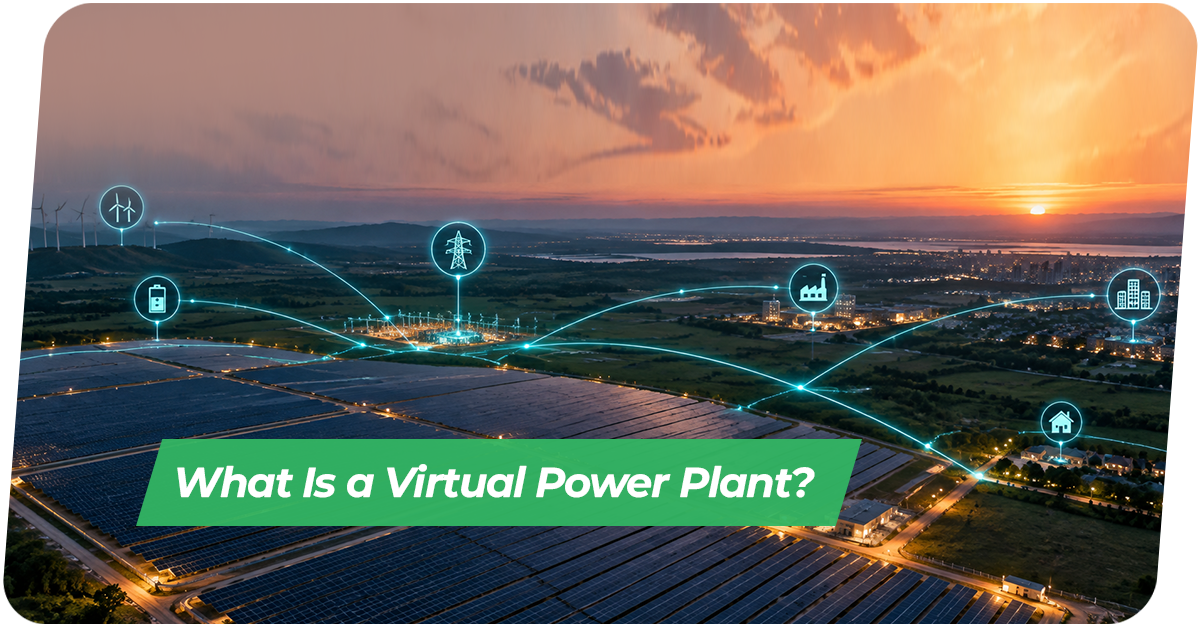
Answer at a glance: A virtual power plant (VPP) is a portfolio of small, distributed energy resources — rooftop solar, batteries, EV chargers, controllable industrial and building loads — linked by software so that a grid operator or an electricity market can call on them as though they were a single power station. VPPs are commercially established in the United States, Europe and Australia; Wood Mackenzie counted 37.5 GW of enrolled VPP capacity across North America in 2025. India does not yet have a commercial virtual power plant, and no Indian statute or notified regulation uses the term. What India does have is a decade of demand response pilots, a central regulation that already permits aggregated resources to sell ancillary services, and two states that have notified demand-flexibility obligations on their distribution companies. |
The phrase appears more often each year in Indian energy conversations — in policy drafts, in investor material, in utility announcements — and it is used to mean several different things. This piece sets out what a virtual power plant actually is, how it differs from the three concepts it is most often confused with, how large VPPs have grown in the markets that have built them, and precisely where India stands today. The accurate answer to that last question is more interesting than the promotional one.
|
Definition: A virtual power plant is an aggregation of distributed generation, energy storage and controllable loads, coordinated through software so that the portfolio can be dispatched as a single resource in power system operations and electricity markets. The assets remain physically dispersed and separately owned. What is centralised is the control layer and the market interface — not the hardware. |
Two institutional definitions are worth quoting directly. The US Department of Energy describes VPPs as "aggregations of DERs that can balance electricity demand and supply and provide utility-scale and utility-grade grid services." The Australian Energy Market Operator, which has run one of the longest national VPP demonstrations, uses more careful language: "an aggregation of resources (such as decentralised generation, storage and controllable loads) coordinated to deliver services for power system operation and electricity markets."
The word doing the work in both definitions is coordinated. A thousand rooftop solar systems on a distribution feeder are not a virtual power plant. They become one when a control platform can forecast their combined output, instruct them, verify what they did, and sell the result. The International Energy Agency, reviewing the category in 2023, noted that VPPs "remain uneven across geographies and have yet to reach the fully commercial stage."
|
Definition: Distributed energy resources (DERs) are small generation, storage and load assets located on the distribution network or behind a consumer’s meter, rather than connected to the transmission system. Individually they sit below the threshold at which a system operator can see or dispatch them. Aggregated, they can be made visible and controllable. |
The Department of Energy’s working list of DERs is a useful inventory: rooftop solar with behind-the-meter batteries, electric vehicles and their chargers, electric water heaters, smart buildings and their controls, and flexible commercial and industrial loads. Two features unite them. Each is small — kilowatts, not megawatts. And each belongs to somebody who bought it for their own reasons, which is why enrolment, consent and consumer trust matter as much to a VPP as any engineering question.
Storage is the resource that changes what an aggregation can do, because a battery energy storage system can both absorb and export, and can hold its response for a defined duration. Solar can only be curtailed, and a controllable load can only be shifted or shed. For readers new to the underlying technologies, our explainer on how renewable energy works covers the generation side.
Four things have to happen, in order.
|
Layer |
What happens |
Why it is hard |
|
Enrolment |
Owners of distributed assets contract into the portfolio, usually for a payment or a tariff benefit, and grant the operator permission to control or influence their device. |
The Department of Energy identifies three principal adoption barriers: high upfront device cost with limited low-cost financing, split incentives between property owners and tenants, and knowledge gaps about the programmes and incentives available. Willingness to hand control of a device to a third party is a fourth, and the least amenable to engineering. |
|
Telemetry |
The platform reads what each asset is doing, at intervals short enough to matter to the grid. |
Communication often runs over household internet connections rather than utility-grade networks. In Australia’s national demonstration, the market operator received between 70% and 98% of expected telemetry from each participant at any one time. |
|
Optimisation and dispatch |
Software forecasts the portfolio’s availability, bids it into a market or responds to an operator signal, and instructs thousands of devices through manufacturer interfaces or price signals. |
Forecasting a dispersed portfolio is materially harder than forecasting a plant. The same Australian trial measured normalised mean absolute error of 12–13% for VPPs against 2–5% for large-scale solar over identical periods. |
|
Measurement and settlement |
The delivered service is quantified and paid for. |
Generation can be metered. A load reduction cannot. It has to be estimated against a counterfactual baseline — what the consumer would have drawn had nothing happened. Regulators have standardised methodologies for this, but the estimate is structural, not incidental. |
That fourth row is the one most explanations skip. In the United States, the framework document on measurement and verification for demand-side resources puts it plainly: "It is not possible to meter or otherwise directly observe load reductions." Everything downstream — price signals, cost-effectiveness tests, capacity credit — inherits whatever bias sits in the baseline.
These four are routinely used interchangeably. They are not the same thing, and a technically literate reader will notice.
|
Concept |
What it is |
The distinguishing feature |
|
Virtual power plant |
A geographically dispersed portfolio of generation, storage and controllable load, coordinated by software. |
No defined electrical boundary and no ability to island. It behaves like a plant at the market interface only. |
|
Microgrid |
In the Department of Energy’s definition, "a group of interconnected loads and distributed energy resources within clearly defined electrical boundaries that acts as a single controllable entity with respect to the grid." |
It can disconnect and keep a defined site energised when the wider grid fails. A VPP cannot do this. |
|
Demand response |
Incentives to shift or shed electricity demand to help balance the grid. |
Traditionally one-directional and event-driven: load comes down against a baseline when called. |
|
Conventional power plant |
A single generating asset at a single point of interconnection. |
Its output is physically metered at one connection point and it can be dispatched without reference to anyone’s consent. |
The VPP-versus-demand-response line is a spectrum rather than a boundary. A VPP coordinates bidirectional resources, optimises continuously rather than event by event, and stacks several revenue streams; classic demand response curtails load when called. But the Department of Energy’s own 2023 assessment notes that most capacity counted as VPP today sits inside existing demand response programmes. The concepts differ; the statistics overlap. It is not correct to say VPPs have replaced demand response.
|
Not to be confused with: A virtual power purchase agreement (VPPA) is an entirely different instrument. A VPPA is a financial contract for differences that lets a buyer claim the environmental attributes of a renewable project without taking physical delivery of its electricity. It aggregates nothing and controls nothing. India now has notified guidelines for virtual power purchase agreements, gazetted in January 2026 — and none at all for virtual power plants. The two terms share two words and no substance, and Indian search results for "virtual power plant" return large numbers of VPPA pages. |
Large enough to matter in some markets, and considerably smaller than the headlines suggest in most.
|
Market |
Reported scale |
Basis and date |
|
North America |
37.5 GW of behind-the-meter flexible capacity across 1,940 active deployments, up from 1,459 deployments and 13.7% higher year on year |
Wood Mackenzie, September 2025. This is the dataset the US Department of Energy has drawn on; DOE’s January 2025 update cited the prior-year figure of 33 GW. |
|
United States (pathway) |
80–160 GW by 2030, roughly 10–20% of peak demand |
US Department of Energy, 2023, reaffirmed January 2025. A deployment pathway, not a forecast. |
|
Great Britain |
1.98 million meters registered; 3,917.7 MWh delivered across 44 events; average delivery performance 71.9% |
National Energy System Operator, Demand Flexibility Service, winter 2024-25 season report. |
|
Puerto Rico |
500 MW of household battery capacity enrolled across 81,104 customers; 49 activations averaging 33 MW delivered |
LUMA programme data, June to October 2025, as analysed by IEEFA. |
|
Germany |
Around 250 MWh aggregated across approximately 25,000 home batteries |
sonnen, August 2023. |
|
Australia |
31 MW across eight portfolios, seven aggregators and about 7,150 consumers |
AEMO national VPP demonstration, knowledge-sharing report, September 2021. |
|
Global demand response |
Approximately 100 GW utilised worldwide, of which roughly 75 GW is industrial |
International Energy Agency, Electricity 2026 (2024 data). Demand response, not VPP — a wider category. |
Read those figures carefully, because most of them are enrolment numbers. Puerto Rico offers the clearest illustration available anywhere: 500 MW of household battery capacity signed into the programme, and an average of 33 MW actually delivered per activation across 49 events in one summer. Great Britain’s system operator measured average delivery performance of 71.9% across its 2024-25 winter season, with 3,917.7 MWh delivered against 5,449.6 MWh bid. Neither programme failed — both did what they were designed to do — but enrolled capacity and dispatchable capacity are different quantities. Conflating them is the most common error in this subject.
Ambition and delivery can also diverge over time. The South Australian VPP was announced in 2018 as 250 MW and 650 MWh across 50,000 homes. When AGL acquired it from Tesla in July 2025 it comprised roughly 7,000 systems. That is a real, operating asset providing real services; it is not the number in the press release seven years earlier.
Not in commercial form, and not under that name. No Indian statute, rule or notified regulation defines a virtual power plant. Every documented Indian programme is described by its own operator as demand response, automated demand response, behavioural demand response or demand flexibility. When GIZ examined the question for India in 2019, it treated virtual power plants as a future opportunity rather than a current practice, and recommended the country begin with pilots at varying scale and location. India duly did. The Council on Energy, Environment and Water counts eleven documented Indian demand response pilots between 2012 and 2025.
Here is what has actually been built and reported.
|
Year |
Programme |
Reported scale |
|
2015 |
Honeywell and Tata Power-DDL automated demand response, Delhi |
11.5 MW of peak reduction across more than 160 commercial and industrial facilities. Described at the time as the first automated demand response initiative for C&I buildings in India. |
|
2021 |
Tata Power-DDL and AutoGrid AI energy management pilot, Delhi |
4,000 residential consumers over three months, controlling residential air conditioning. Capacity not reported. |
|
2023 |
BSES Yamuna and Schneider Electric automated demand response pilot, Delhi |
48 households across four residential societies; 1–5 kW of measured reduction on the analysed cluster. |
|
2024 |
Tata Power and the Municipal Corporation of Greater Mumbai demand-flexibility pilot |
345 kW shifted for three hours a day over 23 days at one water pumping station, moving load into solar hours. |
|
2025 |
Tata Power Mumbai instant-reward demand response event, 29 November |
More than 1,500 smart-meter customers reducing non-essential load for one hour, rewarded by instant UPI transfer. Capacity not reported. |
|
FY2025-26 |
Tata Power group demand flexibility, as reported in its integrated annual report |
38.7 MW in total — 20.6 MW of load increment during solar hours and 18.1 MW of curtailment. |
|
A note on Indian demand response figures: Many published Indian numbers are cumulative — the sum of load reduced across every event in a year — rather than the capacity available in any single hour. Tata Power-DDL’s behavioural demand response programme, for example, reported 560 MW of cumulative reduction across FY2024 from about 101,000 enrolled customers. That is a substantial and genuine result. It is not a 560 MW resource. When an aggregated demand-side programme is compared with a power station, the comparable quantity is what can be delivered within a single dispatch interval. |
More thoroughly than the absence of the phrase "virtual power plant" would suggest. The building blocks are being put in place in a deliberate sequence, and several are already notified and in force.
|
Instrument |
What it establishes |
Status |
|
CERC (Ancillary Services) Regulations, 2022 |
Eligibility to provide ancillary services extends to "a generating station or an entity having energy storage resource or an entity capable of providing demand response, on standalone or aggregated basis, connected to inter-State transmission system or intra-State transmission system". That phrase is the legal foundation for aggregation in India — and its closing qualifier is the reason every registered provider today is transmission-connected. |
Notified 31 January 2022; provisions brought into force in stages, with the tertiary reserve provisions effective 1 April 2023. |
|
Tertiary reserve ancillary service on the exchanges |
A traded ancillary services product across all three power exchanges. Grid-India reported 169 registered providers representing 141 GW in July 2025, and mark-up of ₹983 crore disbursed between July 2021 and March 2025 — all of it transmission-connected generation and storage. |
Live since 1 June 2023. |
|
KERC (Ancillary Services) Regulations, 2025 |
Mirrors the CERC eligibility language for intra-state resources in Karnataka, including provision "on a standalone or aggregated basis", with a minimum response of 10 MW. |
Gazetted 15 July 2025. |
|
MERC Demand Flexibility and DSM Regulations, 2024 |
Among the first notified demand-flexibility portfolio obligations on Indian distribution companies: 1.5% of the previous year’s peak demand in FY2025-26 and FY2026-27, rising through 2.0% and 2.5% to 3.5% by FY2029-30, with a symmetric incentive and disincentive of ₹0.20 crore per MW. |
Notified 19 November 2024, Maharashtra. |
|
RERC Demand Flexibility / DSM Regulations, 2026 |
Extends the Maharashtra model and adds what appears to be the first registration route for aggregators in India — registration with the distribution company rather than a licence, with the aggregator and the independent verification agency required to be separate entities, and mandated open protocols including OpenADR, IEEE 2030.5 and OCPP. Obligation rises from 0.25% of peak demand in FY2026-27 to 2.0% by FY2029-30, on the same ₹0.20 crore per MW symmetric basis. |
Notified April 2026, Rajasthan. |
|
Electricity (Rights of Consumers) Amendment Rules, 2023 — Rule 8A |
Time-of-Day tariffs: a peak-period tariff of not less than 1.20 times the normal tariff for commercial and industrial consumers above 10 kW, and a solar-hours tariff at least 20% below normal, across eight solar hours specified by the State Commission. |
Published 14 June 2023, effective for commercial and industrial consumers above 10 kW from 1 April 2024 and for other non-agricultural consumers from 1 April 2025 — and immediately for consumers already on smart meters. |
|
Green Energy Open Access Rules, 2022, as amended 23 May 2023 |
Permits the 100 kW eligibility threshold to be met through a single connection or multiple connections within the same electricity division of a distribution licensee, with no limit for captive consumers. This is the aggregation route that exists and works today for large electricity users. |
In force. |
|
CEA (Cyber Security in Power Sector) Regulations, 2026 |
Requires that application, monitoring and control servers and real-time data handled by vendors managing distributed generation resources be held in an encrypted, protected environment and remain only in India, with remote access and operation over secure, authenticated and encrypted channels. |
Notified 31 July 2026; effective 1 April 2027. |
Policy direction is also on the record. The Ministry of Power’s draft National Electricity Policy 2026, released for consultation on 21 January 2026, signals an intent to introduce aggregators that pool demand and supply, to improve market access for prosumers, storage and electric vehicles, and to enable trading of surplus energy from distributed renewables and consumer storage either peer to peer or through aggregators. The draft Electricity (Rights of Consumers) Amendment Rules 2026, issued in March 2026, propose a new rule under which State Commissions would specify eligibility criteria for demand response providers, incentives for participating consumers, communication protocols, and procedures for measurement, verification and financial settlement. Both remain drafts and should be read as direction of travel rather than current law.
Three things, and they are being addressed in a sensible order.
Metering comes first. An aggregated demand-side product cannot be measured or settled without interval metering at the point of consumption. India had 7.24 crore smart meters installed nationally as on 30 June 2026 against 20.33 crore sanctioned under the Revamped Distribution Sector Scheme, which runs to 31 March 2028. The Ministry of Power identifies improved load forecasting and data analytics for demand-side management as direct benefits of that rollout. Everything else depends on it.
Market access follows metering. The exchange segments relevant here require a grid-connected entity holding standing clearance from the relevant load despatch centre through the NOAR portal. A behind-the-meter battery or a controllable factory load does not meet that description today. The aggregation route that does exist for large electricity users is green energy open access at an aggregated 100 kW threshold — which is why India’s renewable open-access market has grown quickly while behind-the-meter aggregation has not.
Standards and consent complete the set. India has no central aggregator registry and no national telemetry standard; Rajasthan’s 2026 regulations appear to be the first Indian instrument to name specific open protocols. Nor is there yet a standardised consent mechanism for third-party access to smart-meter data. Because distribution is a state subject under the Constitution, these frameworks are being assembled state by state — Maharashtra in 2024, Karnataka in 2025, Rajasthan in 2026 — with central policy setting direction. That is the constitutional design working as intended, not a gap.
The raw material is already substantial. India had 30.7 GW of grid-connected rooftop solar as on 31 July 2026 and a fast-growing electric vehicle fleet served by more than 52,700 public charging stations as at July 2026, alongside a rapidly expanding fleet of grid-scale batteries. None of it is currently dispatchable as a portfolio.
The need is equally clear, and it is a growth story rather than a shortfall story. India’s all-time peak demand now stands at 270.8 GW, reached on 21 May 2026; the previous record of 256.1 GW, on 25 April 2026, was met in full with no shortage. The Central Electricity Authority’s Long-Term National Resource Adequacy Plan, published in March 2026, projects peak demand of 345 GW by 2029-30 and 459 GW by 2035-36, and identifies a requirement for 80 GW and 321 GWh of battery storage and 94 GW and 567 GWh of pumped storage by 2035-36. We have written separately about what India’s energy storage build-out implies for the decade ahead.
Independent analysis suggests aggregation could contribute meaningfully to that requirement. The Council on Energy, Environment and Water estimates India’s grid flexibility requirement will grow five- to sixfold by 2030, and that shifting demand into solar hours could avoid roughly ₹14,000 crore in battery and transmission infrastructure costs. FSR Global estimates that demand-response-enabled air conditioners alone could take 8–10 GW off India’s peak demand by 2030 if around half of projected units participate. Both are modelled potentials from independent institutions rather than commitments, and both depend on the metering and market-access sequence above.
What aggregation will not do is carry baseload. A virtual power plant reduces or shifts peaks; it does not produce energy around the clock. India’s bulk supply will continue to come from large plants, and the clean-energy portion of it increasingly from utility-scale firm and dispatchable renewable energy contracted to deliver across defined hours, firmed with storage. The interesting proposition is not substitution. It is that a flexible demand side and a firm renewable supply side solve different parts of the same problem, and that India is now building the metering, market and protocol layers that would let both work together.
That is the useful way to read the virtual power plant in an Indian context: not as a product available today, but as the direction in which an increasingly digital, increasingly distributed electricity system is heading. Balancing reliability, sustainability and innovation in a disrupted energy landscape will require both the firm assets that meet demand and the flexible ones that shape it. Accelerating innovation for a secure, sustainable energy future means understanding the second category clearly, and describing it accurately, well before it becomes commonplace.
VPP stands for virtual power plant. In an energy context it refers to a group of distributed assets — solar systems, batteries, EV chargers, flexible loads — that are coordinated by a software platform so they can be operated and traded as a single resource. It is "virtual" because the plant exists only in software; the hardware stays wherever it was installed.
No. A virtual power purchase agreement is a financial contract that lets a buyer secure the price and the environmental attributes of a renewable project without taking physical delivery. A virtual power plant is an operational aggregation of physical assets. The two are unrelated, and the similar names cause considerable confusion in Indian search results.
Yes. Demand response is a recognised, eligible ancillary service at central level under the CERC (Ancillary Services) Regulations 2022, and Karnataka mirrored that eligibility for intra-state resources in 2025. Maharashtra notified a demand-flexibility obligation on distribution companies in 2024 and Rajasthan in 2026. What does not yet exist is a national, market-based demand response mechanism; because distribution is a state subject, these frameworks are being built state by state.
Not for bulk energy. Aggregated distributed resources are well suited to reducing peaks, providing fast reserves and deferring network investment, and they are energy-limited by construction — a household battery holds a few hours of output. They complement firm generation rather than substituting for it.