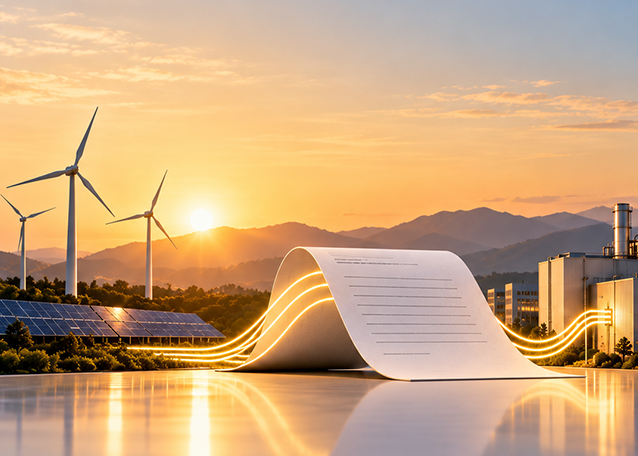

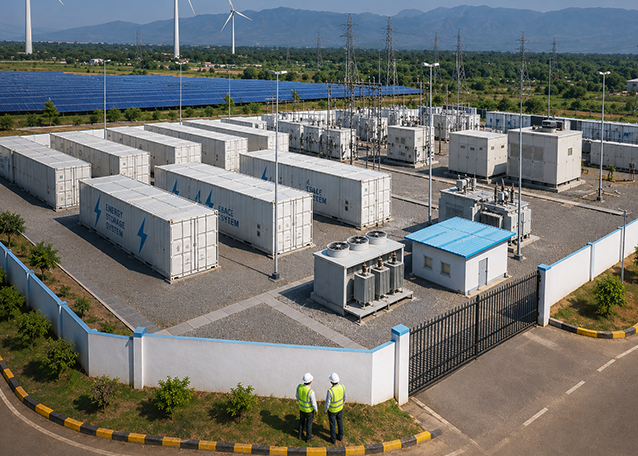
A solar plant on its own produces most of its energy between mid-morning and late afternoon. Most businesses do not consume power that way: factories run shifts into the night, cold chains never switch off, data centres and hospitals cannot pause, and offices draw power well past sunset. A battery closes that timing gap. It charges when the sun is strong and the plant generates more than the facility needs, and it discharges when generation falls and demand does not.
Definition: A solar-plus-storage system combines solar energy and a battery energy storage system in a single installation or contract. The battery acts as a storage system for solar energy — it holds surplus daytime generation and releases it on demand, so the combined system can deliver power in hours when the panels alone cannot.
The mechanics are deliberately invisible to the buyer. Control software decides when to store and when to supply, and the electricity that reaches the facility is indistinguishable from grid power. What changes is the profile: instead of a midday surge of solar and nothing after dark, the business receives a steadier, scheduled supply of clean energy.
The commercial case rests on outcomes, not technology.
Longer clean-power coverage: Solar alone serves only the daylight share of a round-the-clock facility’s consumption. Storage extends that clean supply into the evening and night hours when operations continue.
Budget certainty: Power from a long-term solar-plus-storage contract comes at a predictable cost across the tenure, insulating energy budgets from year-to-year revisions in retail tariffs.
A hedge against rising tariffs: Commercial and industrial consumers pay among the highest retail electricity tariffs in most Indian states, and time-of-day pricing — now implemented across 23 states and five union territories — makes evening consumption costlier still. Stored solar targets exactly those hours.
Less diesel: Batteries can take over much of the bridging role diesel generators have traditionally played, reducing both running cost and emissions.
Progress on climate commitments: Storage converts renewable capacity into supply a business can count towards RE100 or net-zero targets around the clock, not just at midday.
Indian businesses are moving quickly in this direction. The India Energy Storage Alliance projects that commercial and industrial energy storage installations will grow from under 1 GWh in 2025 to 23–31 GWh by 2032, alongside a rise in C&I renewable capacity from about 32 GW to as much as 100 GW over the same period. Industry tracking by Mercom India finds that solar paired with battery storage has become the leading configuration in corporate clean-power procurement. Energy storage systems combined with solar power are becoming the default architecture of the corporate energy transition.
For a commercial buyer, choosing a battery system is less about chemistry datasheets and more about matching the system to how the business consumes power. It helps to bring finance and operations into the conversation early — the right answer depends as much on your load profile and balance-sheet preferences as on the hardware. Six questions cover most of the decision.
How much energy, and for how long? Battery capacity (kWh or MWh) should reflect the hours you need covered — an evening peak, a full night shift, or brief power-quality events. Most commercial systems are sized for two to four hours of discharge at full output.
Power or energy? The power rating (kW or MW) sets how much load the battery can serve at once; the energy rating sets for how long. A cold store and a foundry with the same monthly consumption may need very different combinations of the two.
Which chemistry, and what lifespan? Lithium-ion dominates commercial installations today. What matters to the buyer is cycle life, the degradation curve, and the warranty — how much capacity is guaranteed after ten years, and who bears the replacement risk.
On-site or off-site? Rooftop or captive plants with storage suit facilities with space and steady daytime load. Off-site projects supplying power through the grid under open access suit larger or multi-site consumers. Many businesses combine both.
Buy or contract? A capital purchase puts the asset — and its performance and replacement risks — on your balance sheet. A long-term supply contract with a renewable energy producer shifts sizing, operations, and technology risk to the producer, and converts the entire system into a single, predictable per-unit cost.
Who stands behind it? Storage has to perform for well over a decade. Assess the track record of the developer or supplier, their operations capability, and — for round-the-clock requirements — whether they can firm up supply with more than one generation source.
It can cover far more hours than solar alone — but a genuinely round-the-clock, all-season supply usually takes more than one resource. Extended monsoon spells and seasonal variation mean that portfolios combining solar, wind, and BESS deliver firm power more efficiently than solar and storage alone: wind generates through evenings, nights, and the monsoon months, precisely when solar is weakest. We will soon publish our article on solar-wind-BESS hybrid solutions.
This is the approach Resolven takes for its commercial and industrial customers. With a multi-gigawatt pipeline of solar, wind, hybrid, and storage projects across India, Resolven engineers 24x7 clean power solutions for enterprises — combining solar and battery with wind so that businesses receive dependable green power around the clock, at a cost they can plan around.
What happens at night, or during the monsoon?
The battery supplies stored solar energy after sunset for as many hours as it is sized to cover. Across longer low-sun periods, supply is maintained by the grid or, in hybrid contracts, by wind generation — which in India is strongest during the monsoon months.
How long does a commercial battery system last?
Commercial and grid-scale batteries are typically contracted for ten to fifteen years or longer, with warranties defining the capacity guaranteed over time. In long-term supply contracts, augmentation and eventual replacement are the producer’s responsibility, not the buyer’s.
Do we need to change anything inside our facility?
Usually not. Whether the storage sits on your roof or at an off-site plant, the delivered electricity behaves exactly like the power you use today. The change shows up in the energy bill and its predictability, not in day-to-day operations.
For commercial buyers, solar and battery is the first step towards energy that behaves the way the business does — and, blended with wind, towards genuinely round-the-clock clean supply. It is also a measurable contribution to the sustainability goals that customers, investors, and regulators increasingly track.